Dieses Blog durchsuchen

Posts mit dem Label Vienna werden angezeigt. Alle Posts anzeigen

Freitag, 12. Juni 2015

Vienna again! House of the Sea

As a follow up from yesterday - as I discovered the Gasometer City in Vienna and I wondered what the Austrians could make from such an old industrial huge buildings! -, today I visited another universe in an amazing location (see this material too about a similar location in Vienna).
*The Haus des Meeres (HdM, English: House of the Sea) is a public aquarium in Vienna, Austria. It is located in Esterhazy Park in downtown Mariahilf district, one block south of the busy Mariahilfer Straße. The Haus des Meeres houses over ten thousand aquatic beings on an area of around 4,000 square meters (43,000 sq ft) inside a tall concrete flak tower built during World War II. In 2012 the Haus des Meeres attracted a record high of 436,500 visitors. 
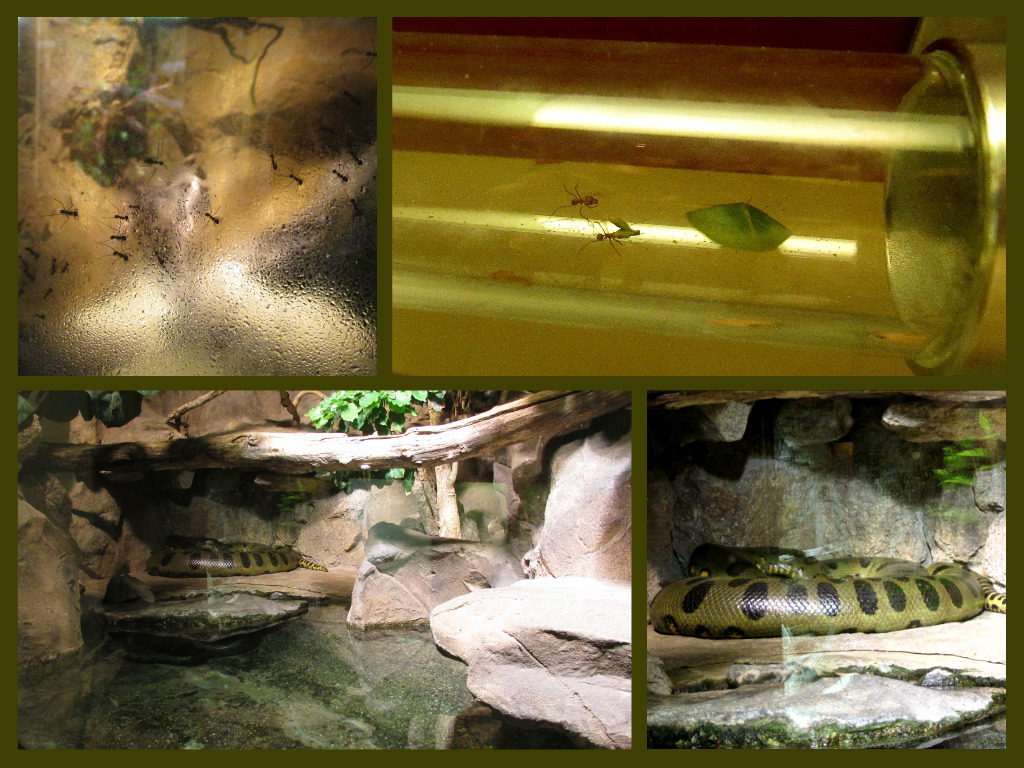
big ants working, carrying, running unstoppable and a sleepy snake
The Haus des Meeres is managed by Aqua Terra Zoo, a private non-profit organization which, according to its web site, receives only marginal financial support from municipal authorities. However, the maintenance costs for the former flak tower are paid by the taxpayer.
Background
The first public seawater aquarium in Vienna was opened in 1860 by Gustav Jäger. Jäger's aquarium, like its contemporaries, relied on regular delivery of natural seawater. It became a reality in 1854 with the construction of the Semmering railway linking Vienna with the Mediterranean coast. After two years of experimenting with small seawater tanks Jäger built a large aquarium for public display. 
He described the feelings of contemporary people who faced the unknown submarine world: "The first-time visitor ... cannot contain his inner excitement. His curiosity is so great that he can hardly enjoy the moment: I am sorry, but he looks so helpless, as if he has suddenly found himself among people whose language he neither speaks nor understands." 
Visitors sought new experience, but resisted believing what they saw behind the glass. The aquarium was a financial loss, and Jäger had to close it after four years of operation.
The concrete tower housing the present-day aquarium was erected as a fire control flak tower in ten months between October 1943 and July 1944. The tower is 47 meters (154 ft) tall, with a footprint of 31 by 15 meters (102 by 49 ft), and its gross volume, including extensive foundations, reaches 55,000 cubic meters (1,900,000 cu ft). 
In 1944 it was crowned with a Würzburg radar dome. In case of imminent air raid threat, the radar could be lowered into a concrete shaft with 3.5-meter (11 ft) thick concrete walls. The subordinate gun battery tower is located inside a city block north of Marihilfer Straße. The two towers operated as a single combat unit, in cooperation with two other pairs of flak towers built in Augarten (north) and in Arenberg Park (south-east). After the war the tower in Esterhazy Park was temporarily used as a hotel with 38 rooms in a bunker, and then converted to a fire station.
History
In the 1960s the underground part of the bunker was used as a youth hostel, named Stadtherberge Esterhazypark.
Volunteers moved into the flak tower in November 1957. The ground floor and the bunkers were then occupied by the firefighters, which left only one and half habitable floors for the exhibition. The rest of the tower was filled with debris and open to the elements. Step by step, the aquarium expanded over the empty floors. Eventually, when the aquarium expanded to six floors, the firefighters left the buildings, and the aquarium staff was at last allowed to clear the basement of war relics.
In 1991 the building was crowned with a lightweight wraparound box with the slogan Smashed to Pieces .. In the Still of the Night (in English and German), a memorial against war and fascism designed by Lawrence Weiner
Eventually it became an obstacle to the expansion plans. The city authorities divided whether Weiner's work was a disposable billboard or a piece of artistic heritage, but by 2005 the latter viewpoint prevailed and the city picked up its maintenance costs. The old elevator, installed in 1944, operated without failure until 1997. It was replaced during an extensive renovation that enabled opening of three new floors (7, 8 and 9). 
The glass wings which house the reptiles and tropical birds, were added in 2000 and 2007. As of 2010, the tower houses ten habitable above-ground floors plus an open sightseeing roof deck. The tenth floor, which recreates a flak turm control vault, houses World War Two exhibits and I was so lucky to be allowed inside today at 4 p.m..
The expansion had a side effect: the City of Vienna struck the "defaced" tower off the list of protected landmarks but enforced preservation of Weiner's billboard.
In 2007 the Haus des Meeres installed its largest, 300,000 liter tank for sharks
On May 7 the aquarium moved six adult blacktip reef sharks, properly sedated, to the new tank. All sharks quietly died in a few hours after awakening. Autopsy revealed fatal internal bleeding which was blamed on stress (after the accident other zoos confirmed that blacktip sharks are, indeed, prone to stress injury). The four replacement sharks of the same species that were delivered next month survived without lasting effects. 
The gravel lining the bottom of the tank was recycled from World War Two concrete which was torn down during the expansion. It is visible on the 55 euro cent commemorative stamp 50 Jahre "Haus des Meeres" issued by the Austrian Post in 2007.

The global financial crisis caused an abrupt drop in visitor numbers of Viennese art museums. The Haus des Meeres, on the contrary, steadily attracted more visitors every year: 258 thousand in 2007, 336 thousand in 2008, 353 thousand in 2009. In 2009 it rose to number ten in the list of Vienna's tourist attractions ranked by ticket sales, despite a significant increase in ticket price. (16 euros today).
Expansion plans 
Further expansion and ownership of the tower is a controversial matter. The property is owned by the City of Vienna, which pays for the maintenance costs, and is determined to get rid of the financial burden. 
In 2008 the City proposed selling the tower to an outside investor and approved plans to build a private hotel on top of the flak tower. The plans were vocally opposed by the residents of Mariahilf. The Haus des Meeres itself wanted to retain future upward expansion rights. They proposed building three new exhibition space floors inside an all-glass capsule shaped like a manta ray
As of 2010, both these projects were canceled. The Haus des Meeres received a vote of confidence from local residents but had to choose a less radical solution. The six million Euro expansion project, scheduled for 2011, will add a million-liter fish tank and an open-air restaurant. 
The city officials are willing to consider the sale of the building to the Haus des Meeres, on condition that the new owner preserves Weiner's artwork and picks up the maintenance bill from the taxpayers.
Source: Wikipedia, what else?! 
Pictures by myself. 
And yes, I enjoyed the terrace on the top indeed (having my meal for today there for 10+2 euros!)
It was a hot day again and I cycled 35 km (62 yesterday).

Donnerstag, 11. Juni 2015

Vienna again: Gasometer City!!!


Petrecerea de Crăciun a firmei s-a ținut într-un fel de cartier al modei și când am ajuns acolo, astă-iarnă, pe întuneric, am văzut așa o construcție circulară foarte mare și denumirea stației de metrou: Gasometer
Eh, m-am gândit io, iaca sediul celor de la gaze (”Distrigaz”), ce mare lucru! OK.....
Astăzi, la aproape 30°C, traversam Viena deja pentru a doua oară în ultimele 24 de ore și tot încercam trasee noi pe ruta de întoarcere spre casă. Eram pe bicicletă, ca-ntotdeauna. 
Și mă rătăcesc. Și ajung la Gasometer
Cum aveam timp și aparatul foto la mine m-am apropiat de imensa clădire …. și apoi mai văd una strâmbă și apoi mă gândesc hai să fac un tur, că nu mă doare spița de la bicicletă! 
Frateeeee ….. și încă un turn, și încă unul și încă un al patrulea ….. mama-mia, ce complex imens!!!

Îmi pare rău că nu m-am uitat pe kilometraj să văd dacă are 1 km runda întreagă. Nu cred, apreciez la 700 m.
Dar tot nu pricepeam ce poate să fie înăuntru, că părea un fel de Mall, un fel de …. apartamente?!?! Deci nici vorbă de ”distrigaz”, nuuuu!!!
Și fac poze, ajung seara târziu acasă și dau pe goagăl …. Și iaca ce descopăr, trăiască internetul!! 
Gasometer din Viena-Simmering este un complex alcătuit din patru foste recipiente de gaz construite inițial în 1896, ale căror fațade au fost menținute. Între 1999 și 2001 întreaga zonă a intrat într-un complex proces de revitalizare, astfel că cele patru foste recipiente de gaz au devenit gazda unui centru de enterteinment, a numeroase apartamente, a unui cămin de studenți și a unei imense hale de festivități.    
Clădirile Gasometer au fost o parte din Uzinele de Gaz Simmering având rolul de a echilibra fluctuațiile alimentării cu gaz ale rețelei orașului Viena.  
Din punct de vedere tehnic ele aveau rolul de acumulator de joasă presiune pentru gazul obținut din cărbuni. La frontiera dintre secolele 19-20 existau în Viena doar două uzini de gaz: Simmering și Leopoldau.

Districtul Simmering este al 11-lea district al Vienei și cele patru clădiri constituie, prin dimensiunea lor, emblema zonei, fiind vizibile de la mari distanțe. Uzina de Gaz Simmering cu cele 4 clădiri a fost funcțională între 1899 și 1975. Din 2001, după încheierea lucrărilor de revitalizare, complexul atrage numeroși turiști din toată lumea, precum și experți din domeniul arhitecturii (de ce m-aș mira??? E ca și cum în interiorul Amfiteatrului din Roma se construiește cel mai mare Mall al Italiei, bașca câteva sute de apartamente, dar dinafară nu-ți dai seama, tu tot marele Amfiteatru Antic vezi …) 
Containerele cilindrice de gaz sub formă de clopot (”Gazometre”) cu un volum de 90.000 metri cubi, care se aflau într-un bazin de apă, au fost încercuite de o fațadă din țiglă.
Gazometrele măsoară, de la nivelul solului până în vârf, 70 m și au un diametru de 60 m.
În 1910 a fost construit un al cincilea gazometru sub formă telescopică, devenind, cu un volum de 150.000 metri cubi, cel mai mare container de gaz din Simmering. Se situa la sud de cele patru recipiente deja existente pe un spațiu care astăzi a devenit teren de sport, fiind demolat în 1981.
Sus: Fotografie din timpul construcției cuptorului - 1897
Jos:  Containere în 1901

Construcția Gasometer s-a derulat între 1896 și 1899 în cadrul proiectului de ridicare a Uzinei de Gaze Simmering pe terenul așa-numitului Spital Cetățenesc unde se aflau pe atunci pajiști și grădini. Cazanele au fost produse de firma Friedrich August Neuman din Eschweiler.
Pe 15 martie 1897 a început construcția clădirii centrale a cuptorului care cuprindea 1.620 de retorte necesare gazeificării cărbunelui. Pe zi se puteau fabrica 432.000 m3 de gaz. Până la momentul respectiv alimentarea cu gaz a orașului se realiza prin Imperial Continental Gas Association (ICGA), cu sediul în Anglia. La încheierea duratei contractului dintre orașul Viena și ICGA orașul a decis să producă singur gazul necesar. La momentul construcției, Uzina de Gaze era cea mai mare din Europa.
În anii 1970 s-a trecut la gazul natural, astfel că din 1984 Uzina de Gaz Simmering a fost închisă.  Clădirile se află din 1981 sub protecția Legii Monumentelor (Denkmalschutz).
În 1995 municipalitatea a organizat un concurs de idei pe tema: ”În ce transformăm Uzina de Gaz Simmering?”
Decizia a fost luată în cele din urmă, astfel că, așa cum scriam și mai sus, complexul a devenit un fel de mini-oraș care combină mai multe aspecte ale societății: munca, locuințele (proprietăți personale, dar și chirie, proprietar fiind statul), distracția. Reamenajarea a costat per total 174 milioane de euro.
Eram obosită și mai aveam drum lung, așa că nu am intrat ..... dar promit să documentez și din interior. Așa arătau containerele pe interior, goale, înainte să înceapă construcția apartamentelor (!!)
Și așa arată astăzi privite din afară .....
Aici cum arată pe interior un cilindru care adăpostește apartamente:
Complexul Gasometer este un fel de oraș în oraș, însumând o suprafață de 220.000 mp. S-a constatat o reală identificare a celor aproximativ 1.500 de locuitori cu spațiul ”orașului lor”, astfel că s-a constituit o imensă comunitate, atât în virtual, cât și în real. Pe acest subiect s-au concentrat numeroase lucrări de diplomă și dizertații din domeniile: arhitectură, psihologie, design arhitectural, publicistică - Gasometer devenind în timp un fenomen.
Se poate ajunge foarte simplu și rapid în imensul domeniu verde al Prater-ului, legătura fiind făcută printr-un pod lung ce traversează artere rutiere, feroviare și fluviale.
După ce m-am îndepărtat amețită de această imensitate arhitecturală, care este orice altceva, dar nu ceea ce pare din exterior, mi-am continuat cotrobăirea semi-haotică în căutarea drumului către casă :-) și am găsit poteca traversând taman podul despre care povesteam adineauri. A fost o revelație, căci din Prater ajung imediat pe Donauinsel și de acolo drumul către casă, fără trafic, este o plăcere întotdeauna. Trăiască Donauinsel!! (care de cum dă căldura devine un fel de grădină zoologică cu mamifere bipede nude în toate pozițiile imaginabile).
DE CITIT - click here
și aici tura de azi, pe bicicletă ... 
Aici poți citi despre ”Casa Mării” din Viena - o altă locație absolut delirantă! O mini-grădină zoologică cu exemplare preponderent marine și amazoniene amenajată într-un fost turn din beton de apărare a orașului împotriva raidurilor aeriene inamice din timpul celui de-al doilea război mondial (!)

Donnerstag, 21. Mai 2015

Walking or cycling through Vienna is always a different piece of delicacy: Votiv Church

To discover Vienna needs time. A lot of time. Depending on your interests there are a lot to be discovered:
*interesting combination of architecture and colors
Vanilla & Schoko - by Anka Berger


*a lot, really a lot of statues of Austrian personalities in all segments of life and society (culture, politic, economy, science, social, sport, entertainment etc.).
Johann Strauss in Stadtpark, Vienna - 13th of May, 2015, 21:30' - by Anka Berger
Vienna is a huge open air museum. It wasn't my dream about Austria. My dream about Austria still remain Salzburger Land. But I enjoy the cosmopolitanism and the variety of this city so long I stay in this area. Vienna offers a generous place for every taste, age, hobby, imagination.
Today I had to ride for about 25 km through wind, cold (about max. 10°C) and rain from my home to Simmering Place in the 11th District of the city. And 25 km back, of course.

The first indications of the settlement Simmering are from 1028. A brewery was built in 1605 and continued to bring in revenue for the area for more than 300 years. Simmering remained small until 1860, when the Rinnböckhäuser housing development was built, which at the time was the second-largest in Vienna, and resulted in rapid growth in the area.
Kaiserebersdorf (earlier known as Ebersdorf) was one of the original villages in the district and held the residence of the Ebendorfer dynasty. Holy Roman Emperor Maximilian II hunted frequently in the area and converted the residence into the hunting lodge Schloss Neugebäude.
On January 1, 1892, Simmering, Kaiserebersdorf, and some very small parts of Kledering, Schwechat, and Albern were incorporated into Vienna as the 11th district.
On my way back I reached the Votiv Church which I always saw from distance and never had time to go closer. 
Due to a translation project I had last April regarding the sightseeing monuments of Vienna I knew the church has a quite interesting history and a unique architecture.
Today I just reached it by chance and I took the time to go inside discovering a new image from my adolescence times, the statue of St. Anton (!), my Protector in the 80ies (13th of June will be celebrated, big even in St. Josef Cathedral in Bucharest).
The Votive Church (German: Votivkirche) is a neo-Gothic church located on the Ringstraße in Vienna, Austria. Following the attempted assassination of Emperor Franz Joseph in 1853, the Emperor's brother Archduke Ferdinand Maximilian inaugurated a campaign to create a church to thank God for saving the Emperor's life. Funds for construction were solicited from throughout the Empire. The church was dedicated in 1879 on the silver anniversary of Emperor Franz Joseph and his wife Empress Elisabeth.
Votiv Church, Vienna - 21th of May 2015, by Anka Berger
Construction began in 1856, and it was dedicated twenty-six years later on April 24, 1879, the occasion of the silver jubilee of the royal couple.
The church was one of the first buildings to be built on the Ringstraße. Since the city walls still existed at that point, the church had no natural parishioners. At that time it was meant as a garrison church, serving the many soldiers that had come to Vienna in the wake of 1848 Revolution.
Votiv Church, Vienna - 21th of May 2015, by Anka Berger
 The church is not located directly on the boulevard but along a broad square (the Sigmund Freud Park) in front of it. The Votivkirche is made out of white sandstone, similar to the Stephansdom, and therefore has to be constantly renovated and protected from air-pollution and acid rain, which tends to colour and erode the soft stone.

The church has undergone extensive renovations after being badly damaged during World War II.
Since its architectural style is quite similar to the Stephansdom, it often gets mistaken for it by tourists. In reality the two churches differ in age by more than 700 years.
The church is well worth investigating on the inside too. The Tomb of Count Nikolas von Salm, the saviour of Vienna in the 1529 siege and the stained glass window should be seen. It is an unusual church in that the spires are topped by the Imperial crowns rather than the normal crucifixes.


Freitag, 8. Mai 2015

Madam Tussauds Wax Figures Museum_01

Madam Tussauds Works are inside the Wurstelprater in Vienna. 
I was curious to see them and today was the big day of going inside after I let me being child again :-)
It is an interesting area, although somehow I had greater expectations. 
At the end I just have had the feeling "a lot of other important people" are missing from this collection!
The saloons are in historical chronological order, so let's start with a short journey in time:
Maria Theresia  von Österreich (1717-1780) and Franz I. Stephan (1708-1765)
Maria Theresa Walburga Amalia Christina (13 May 1717 – 29 November 1780) was the only female ruler of the Habsburg dominions and the last of the House of Habsburg. She was the sovereign of Austria, Hungary, Croatia, Bohemia, Mantua, Milan, Lodomeria and Galicia, the Austrian Netherlands and Parma. By marriage, she was Duchess of Lorraine, Grand Duchess of Tuscany and Holy Roman Empress.
She started her 40-year reign when her father, Emperor Charles VI, died in October 1740. Charles VI paved the way for her accession with the Pragmatic Sanction of 1713 and spent his entire reign securing it. Upon the death of her father, Saxony, Prussia, Bavaria, and France all repudiated the sanction they had recognised during his lifetime. Prussia proceeded to invade the affluent Habsburg province of Silesia, sparking a nine-year conflict known as the War of the Austrian Succession, and subsequently conquered it. Maria Theresa would later unsuccessfully try to reconquer Silesia during the Seven Years' War.
Maria Theresa and her husband, Francis I, Holy Roman Emperor, had sixteen children, including the Queen of France, the Queen of Naples and Sicily, the Duchess of Parma and two Holy Roman Emperors, Joseph II and Leopold II. Though she was expected to cede power to Francis and Joseph, both of whom were officially her co-rulers in Austria and Bohemia, Maria Theresa was the absolute sovereign who ruled by the counsel of her advisers. She criticised and disapproved of many of Joseph's actions. Although she is considered to have been intellectually inferior to both Joseph and Leopold, Maria Theresa understood the importance of her public persona and was able to simultaneously evoke both esteem and affection from her subjects.
Napoleon Bonaparte: 1769 - 1821
Napoléon Bonaparte , born Napoleone di Buonaparte; 15 August 1769 – 5 May 1821) was a French military and political leader who rose to prominence during the French Revolution and its associated wars
As Napoleon I, he was Emperor of the French from 1804 until 1814, and again in 1815. Napoleon dominated European affairs for nearly two decades while leading France against a series of coalitions in the Revolutionary Wars and the Napoleonic Wars. He won several of these wars and the vast majority of his battles, rapidly conquering most of continental Europe before his ultimate defeat in 1815. One of the greatest commanders in history, his campaigns are studied at military schools worldwide and he remains one of the most celebrated and controversial political figures in Western history. 
In civil affairs, Napoleon implemented several liberal reforms across Europe, including the abolition of feudalism, the establishment of legal equality and religious toleration, and the legalization of divorce. His lasting legal achievement, the Napoleonic Code, has been adopted by dozens of nations around the world.
Napoleon was born on the island of Corsica to a relatively modest family of noble Italian ancestry. From 1789, Napoleon supported the Revolution and tried to spread its ideals to Corsica, but he was banished from the island in 1793. In 1795, he saved the French government from collapse by firing on the Parisian mobs with cannons, an event known as the 13 Vendémiaire. The Directory then appointed him as General of the Army of Italy at age 26. After marrying Joséphine de Beauharnais in March 1796, he started the Italian military campaign and scored a series of decisive victories that made him famous throughout Europe. In 1798 he launched a military expedition to Egypt, conquering the Ottoman province with a critical victory at the Battle of the Pyramids and facilitating the rise of modern Egyptology.
SISI - Elisabeth of Austria : 1837 - 10.09.1898
Elisabeth of Austria (24 December 1837 – 10 September 1898) was the wife of Emperor Franz Joseph I, and thus Empress of Austria and Queen of Hungary.
Born into Bavarian royalty, Elisabeth (Sisi) enjoyed an informal upbringing, before marrying Franz Joseph when she was 16 years old. The marriage catapulted her into the much more formal Habsburg court life, for which she was ill-prepared and which she found uncongenial. Early in the marriage she was at odds with her mother-in-law, Princess Sophie, who took over the rearing of Elisabeth's daughters, one of whom died in infancy. The birth of a male heir Rudolf improved her standing at court, but her health suffered under the strain, and she would often visit Hungary for its more relaxed environment. She came to develop a deep kinship with Hungary, and helped to bring about the dual monarchy of Austria–Hungary in 1867.
The 1889 death of her only son Rudolf, and his mistress Mary Vetsera, in a murder–suicide tragedy at his hunting lodge at Mayerling, was a shock from which Elisabeth never recovered. 
She withdrew from court duties and traveled widely, unaccompanied by her family. She was obsessively concerned with maintaining her youthful figure and beauty, this obsession taking the form of, among other things, a requirement that she be sewn into her leather corsets and spending two or three hours a day on her coiffure. 
While travelling in Geneva in 1898, she was stabbed to death by an Italian anarchist who selected her because he had missed his chance to assassinate Prince Philippe, Duke of Orléans, and wanted to kill the next member of royalty that he saw. Elisabeth was the longest serving Empress-consort of Austria, at 44 years.
to be followed ....

I'm WATCHing YOU!! :-)